

You might think managing SEO for multiple locations simply means duplicating your main strategy across each branch, but that approach consistently underperforms in local pack rankings. When you’re operating service businesses across different markets, you’re competing against hyper-local competitors who’ve built deep community relevance. The data shows location-specific optimization signals carry significant weight in Google’s local algorithm. What follows is AI Marketing Team’s multi-location local SEO strategy, a technical framework that addresses the exact ranking factors most multi-location businesses overlook. We’ve helped dozens of service businesses scale their local visibility without the copy-paste chaos.
Key Takeaways
- Use subfolder architecture (domain.com/locations/city-name/) to consolidate domain authority while targeting each specific location effectively.
- Maintain consistent NAP details across all directories and Google Business Profiles to build unified trust signals.
- Create unique, hyper-local content for each location page featuring community landmarks, testimonials, and area-specific services.
- Optimize Google Business Profiles with location-specific keywords, weekly posts, and 24-hour review responses to boost engagement signals.
- Implement systematic citation management and CRM-triggered review requests to strengthen local authority and ongoing trust building.
Why Most Multi-Location SEO Strategies Fall Short
When businesses scale to multiple locations, their SEO strategies often collapse under the weight of operational complexity. You’re not alone if your local seo efforts have stalled despite significant investment.
The primary culprits are predictable yet devastating. Copy-paste location pages generate duplicate content that signals low value to search engines, eroding your authority across every branch. Without consistent nap details, name, address, phone, across directories and platforms, you’re fragmenting the trust signals Google relies on for rankings.
Your website architecture matters equally. Poor structure blocks authority flow, preventing search engines from connecting your core services to specific locations. Meanwhile, neglected Google Business Profiles and stale reviews create engagement gaps that trigger ranking instability. These operational failures compound, leaving your locations invisible to high-intent local searchers.
Building a Scalable Website Architecture for Multiple Locations

Because your site structure directly determines how search engines distribute ranking authority across branches, you’ll need a subfolder architecture (domain.com/locations/city-name/) rather than subdomains or separate domains. This consolidated site architecture preserves domain equity while signaling clear geographic relevance to crawlers.
Your dedicated location pages must include these crucial elements:
- Unique URLs with city-specific targeting and service details
- Localized schema markup identifying each branch’s NAP data
- Internal links connecting your main locations hub to individual pages
- Location-specific content addressing community needs
Optimizing Google Business Profiles Across Every Branch
While your website architecture establishes the foundation for local search visibility, your Google Business Profiles serve as the primary driver of Map Pack rankings, where 42% of local searchers click first.
| Element | Action | Impact |
|---|---|---|
| NAP Data | Verify accuracy across all listings | Trust signals |
| Terms | Add location‑specific terms to descriptions | Ranking relevance |
| Reviews | Respond within 24 hours | Engagement metrics |
| Posts | Update weekly with promotions | Freshness signals |
| Schema | Implement structured data markup | Enhanced visibility |
Don’t overlook review management; Google weighs response rates and recency heavily. Your community notices when you’re actively engaged.
Creating Location-Specific Content That Drives Local Traffic
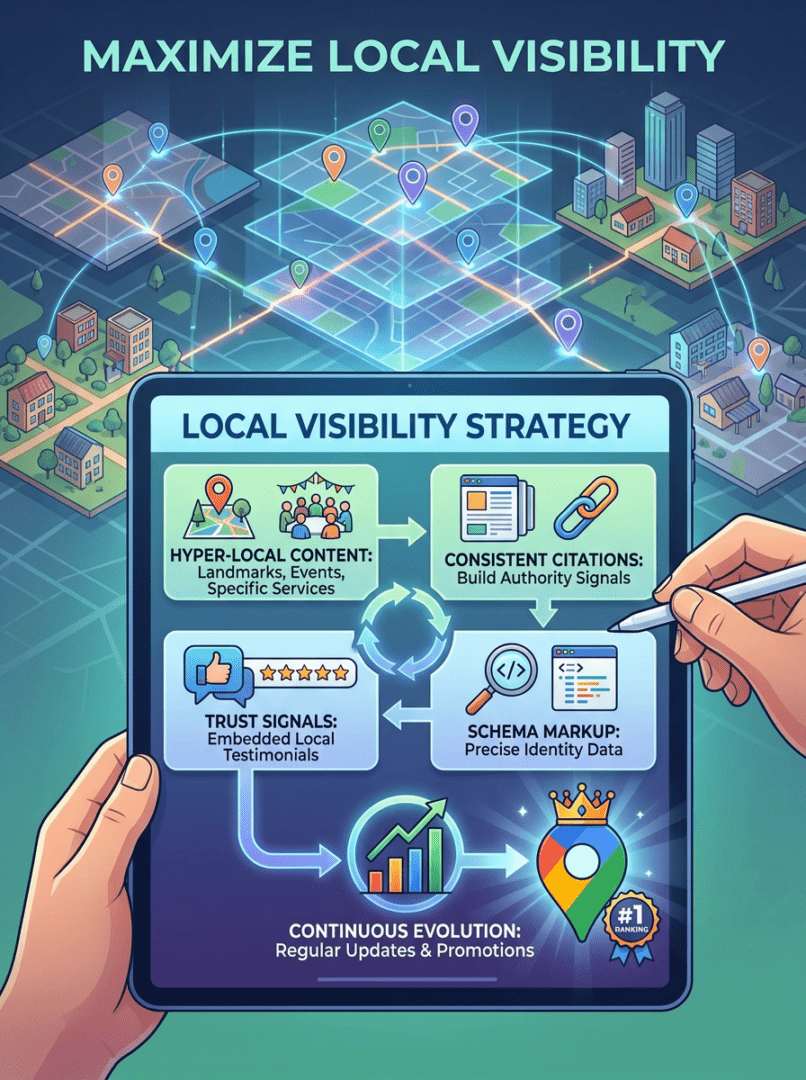
Outside of optimized Google Business Profiles, your location-specific content strategy determines whether individual branches capture high-intent local traffic or get buried beneath competitors. When you create location pages, each must feature unique content that resonates with your community’s specific needs and search behaviors.
To maximize local visibility, implement these proven tactics:
- Develop hyper-local content highlighting neighborhood landmarks, community events, and area-specific service offerings
- Build consistent local citations across directories to reinforce geographic authority signals
- Embed location-specific testimonials that establish trust within your target community
- Apply LocalBusiness Schema markup to communicate precise identity data to search engines
Your location pages should evolve continuously. Regular updates with local promotions and service announcements signal ongoing relevance, strengthening your position within each community you serve.
Managing Citations and Reviews to Strengthen Local Authority
When your location-specific content strategy is firing on all cylinders, citations and reviews become the reinforcement layer that validates your local authority across search engines. Consistent citations across directories like Yelp and Apple Maps signal legitimacy to Google’s algorithm, while review velocity directly impacts your local rankings.
| Strategy | Impact on Local Authority |
|---|---|
| CRM‑triggered review requests | 40% higher response rates |
| Responding to all reviews | Increased engagement signals |
| Directory citation consistency | Verified business legitimacy |
| Local backlink acquisition | Strengthened community presence |
You’ll want to implement systematic review acquisition processes and request feedback within 24 hours of service completion. Respond to every review, especially negative ones, to build trust within your community. These engagement signals reinforce your citations and establish your locations as trusted neighborhood fixtures.
Frequently Asked Questions
How Long Does It Typically Take to See Ranking Improvements Across Multiple Locations?
You’ll typically see ranking improvements within 3-6 months per location, though results vary based on competition levels and existing local authority. Your consistent optimization efforts across all branches will compound over time, strengthening your network’s visibility.
What Budget Should Multi-Location Businesses Allocate for Local SEO Efforts?
You should allocate $500-$1,500 per location monthly for extensive local SEO. This covers citation management, review generation, content creation, and GBP optimization. Your investment scales with location count, ensuring each branch receives dedicated attention.
Can Franchisees Manage Their Own Local SEO Without Corporate Oversight?
You can manage your own local SEO, but you’ll achieve stronger results with corporate guidelines ensuring brand consistency. Coordinated citation management and unified review response protocols across locations enhance your collective local authority considerably.
How Do Seasonal Businesses Adjust Their Multi-Location SEO Strategy Throughout the Year?
You’ll adjust your GBP hours, update location pages with seasonal service offerings, and shift phrase targeting based on search volume trends. Schedule content calendars around peak demand periods for each market you serve.
What Tools Best Track Local Ranking Performance Across Dozens of Locations Simultaneously?
You’ll want tools like BrightLocal, Whitespark, or Local Falcon to track rankings across dozens of locations simultaneously. These platforms let you monitor search term performance, citation accuracy, and competitor data at the hyperlocal level.

Conclusion
You’ve got the playbook, now stop pretending that copying your homepage across 47 subfolders counts as “multi-location local SEO strategy.” The data’s clear: businesses implementing location-specific schema, maintaining 95%+ NAP consistency, and generating geo-targeted content see 3x higher local pack visibility.
AI Marketing Team has executed this multi-location local SEO strategy for service businesses nationwide, delivering consistent results. You’re either optimizing each location as its own micro-authority, or you’re handing competitors your market share. Choose wisely. Contact AI Marketing Team today to implement this framework and dominate your local markets.